Looking Back…The BSWPA’s 2009 Blues Challenge
We had great crowds at all three venues. Between the three shows, there were over 350 people attending, proving that the blues are alive and well in the ‘burg. I hope that the audience enjoyed it as much as I did. The semi-final winners were Craig King and Kings Ransom, Felix and the Hurricanes, Jill West and Blues Attack and Ron Yarosz and the Vehicle. The finals’ voting was so close between ALL four bands that I had to recheck the scoring three times. The winner was Felix and the Hurricanes from Altoona, PA. The solo/duo winner was Bubs McKeg and Dr. Blue who had two perfect scores and their other scores were near perfect. Way to go, guys! We also did a live feed from Moondogs to our leader, Jim Weber, who was too ill to attend. He enjoyed it immensely.
Good luck to our winners in Memphis next year. I hope to be there with them and hope that many of you can come support them as well. Thank you to all of the acts that made this year unforgettable. Thanks to the fans that crowed the place to hear some great acts.


MOVE! to the Blues for Fisher House
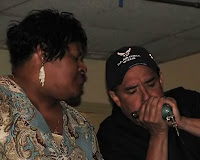
 intent to raise money for the construction of a Fisher House (a Ronald McDonald house for veterans and their families). Almost $2,000.00 was raised and donated toward future Fisher House construction.What made this event something to remember?
 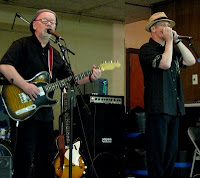 Many wonderful Chinese
A special thank you to the Lawrenceville MOOSE for generously opening their doors for this cause, and to the Lawrenceville VFW, who made delicious food, donating the food and their time in service to attendees.
ADVERTISE WITH US
PLACE YOUR AD HERE
PUBLISHING SCHEDULE
NEXT ISSUE…October 2009
SUBMISSION DEADLINE
Sept 1, 2009
ADVERTING RATES
1/8 PAGE (3 ½” W X 2” H) $35
4 Issues-------$85
¼ PAGE (3 5/8” W X 4 ¾” H) $60
4 Issues------$150
½ PAGE (7 3/8” W X 4 ¾” H) $120
4 Issues------$300
Full Page ads---Call for pricing
CALL FOR INFO.
724-378-8926
2golfers2@comcast.net
Globe Trotting to find the Blues…no distance too far
It was a cold, sunny day in late September when we landed in Prague. (Yes, Prague of the Czech Republic.) Some people travel to see castles, experience the culture, buy souvenirs and try the cuisine. Some look for blues. As globetrotters we always tried to combine all of the above (at least I did and pulled Jim along kicking and screaming). We slowly worked our way through winding brick and cobble stone streets lined with century old buildings that included old shops, cafes and many pubs looking for blues. Jim said that it
Our first stop was at Red, White and Blues. While looking for the highly recommended Trumpett Club, we had taken a wrong turn at the tobacco shop and another at the pastry shop. We walked for quite awhile and at the point of giving up, found ourselves standing outside a quaint, white washed pub that sat across the tiny walkway from a very plush hotel. We walked into what looked like an Irish Pub with green walls, tiled floors, pictures of jazz and blues players on the walls, and Koko Taylor images glazed onto the

We went back the next evening to sample the music of an energetic player who specialized in the songs from the Joe Cocker songbook… “Maybe I’m crazy, maybe you’re crazy, and maybe we’re crazy…” By chance, we were seated beside the owner, Loree Breitmeyer-Jones. At the break, I seized the chance to ask her a few questions about the blues in Europe. Originally Houston, Texas native, she had opened this club sixteen years earlier. My question to Loree, “Okay, what is an American girl doing in Prague???” Loree replied that she had been working in Washington, D.C when the Iron Curtain had fallen. She said that it was a “great time” for American entrepreneurs to get into the hospitality field in Eastern Europe. Her concept was to develop a high end product that had an American style pub-like feel with a menu that included the flavors of Southern, Tex-Mex and Creole cooking. The music followed.
“The people here are amazing! The locals are very supportive of live music. It has been a wild ride!” she exclaimed. She continued to say that jazz is for the more conservative Europeans. Those that love the blues are very supportive of live music. They are more internally entwined with the music and welcome American, Canadian and British Blues. The Blues in Europe does not have to compete with Country and Western music. The Americans in the States lean heavily towards that type and it dilutes the market for the rest of the music genres. The dark haired American beauty added, “There is a real culture here (in Europe) for live music. If you are a performer, you have to perform. There is live music, non-stop, seven days a week in most cities.” The venues are so plentiful in Europe that it is worthwhile for traveling bands to frequent the cities and towns in each region. The venues are constantly networking to connect with bands “on the road” to minimize what they pay and to reduce the bands’ costs. American bands can record in Europe for much lower fees than in the States. An added plus is that the monies paid to the bands are not taxed.
We stumbled upon the Trumpett (also known as Ungelt) quite by accident later that evening. Again, we had taken a wrong turn down a windy little “alley.” I knew that we were getting close when the sound of the blues was drifting up from a cellar window, filling the night air. I was drawn towards the music as if in a hypnotic trance. We circled the building until we found the entrance. Yes, it was finally the Trumpett. After paying a total of twenty-five dollars cash at the door (no credit cards), we gingerly made our way down three, steep flights of stairs into the inner depths of the old building. We first passed through the “upper basement” that housed a summer garden and several bars. Finally we reached the bottom floor (cellar). There was a suspended wooden balcony. We traveled so far down into the Romanesque, underground vault that I was woozy from the descent. The “club” had walls that were covered with stones. Arched ceilings gave the old, sagging ceiling a charming, quaint look. We soon found ourselves seated at a rickety wooden table. The stage was almost as big as the room.

Across from our hotel we ended each evening at the Metropolitan Grill. The upscale, trendy lounge had twenty-five foot ceilings, black trimmed windows, and parquet floors. Lively, colorful murals of Count Basie, Miles Davis, Ray Charles, Etta Cox and B.B King covered the walls. The trendy, young audience was enjoying Mojitos, cosmos, beers, wines, espressos and cappicinos. Old timers like ourselves peppered the room. We all managed to blend in and enjoy the music. Each night they had some type of blues. One night a single played. He had a T-Bone Walker sound. The next evening a duo entertained with the mellow likes of, “The Thrill is Gone.” They had very different takes on the old standards of Blues. The last night, a trio entertained. They took rock songs and gave them a very interesting twist of blues. Yes, the blues is alive and well in Europe …even as far as Eastern Europe. Who would have thought? It was an added pleasure to see the “wonders of the world” and to experience a wonderful “dose” of the blues.

Interview with Robert Cray
Robert Cray: Hi Don. This is Robert Cray.
Don Vecchio: Hi Robert. Welcome back to the States. How did the Blues go in Japan?
RC: Thanks. The Blues are always welcomed with open arms in Japan.
DV: Really? I had heard a bit but had no idea. Has it been that way for a while or has it been recent?
RC: Oh, for many years. I first played in Japan in the early 80’s with John Lee Hooker. There was a huge line of people with old John Lee albums to be signed.DV: That’s incredible. I know you have a bittersweet story about Johnny Guitar Watson while you were performing in Japan.
RC: Yes, I was scheduled along with him at the Japan Blues Carnival (1996). I met him on the elevator and was excited. Later that night, he died on stage. It was such a tragedy.
DV: I’m sorry to hear that. He was a great talent and a good person, I’m sure. Speaking of great talents, I was watching an incredible video on youtube. The longer it went, the more amazed I was. It was listed as “Let the Good Times Roll” BB King and Albert King. I started watching. One by one comes- Junior Wells, you, Dr. John, Etta James, KoKo Taylor, Ry Cooder, Willie Dixon! WOW! Where and when was that filmed? How did they assemble all that talent on one stage?
http://www.youtube.com/watch?v+k610AxIEBtw
RC: Oh, yeah. That was the Grammy Awards back in the late 80’s. There was that wild sax player, too.
DV: Big Jay McNeely-he was crawling backwards on the stage while playing.
 RC: That’s it exactly! (laughs)
DV: You know you all sounded like you’d been playing together for years. How can you all do that with short practice time?
RC: It’s easy. You practice for an afternoon and you’re so scared you’ll be the one who screws up. You play the best you possibly can (laughs). The hardest part was that Ry Cooder and I tried to adjust to the way Albert King tunes his guitar. It was different and a little difficult.
DV: Robert, You have a pretty unique style on guitar and your music, itself. I really can’t look at any performer and say, “That’s where Robert Cray got his style.” Who were your influences?
RC: Well, that’s tough to pinpoint. My father was in the Army in Germany. That’s where I first got into music. We listened to Armed Forces radio. There was a mix: my dad liked Sara Vaughan and Ray Charles; my mother liked the singers like Sam Cooke and the Dixie Hummingbirds. It was from 1961-1963. I played the piano back then. After that, we moved back to Washington State. I quit the piano and picked up the guitar. I wanted to be a Beatle.
DV: (laughing) I think we all did back then.
RC: True, but then I listened and played Jimi Hendrix. He was from the area. The following year we moved to Newport News, Virginia and then I joined my first band. We played Hendrix and other rock. Then we moved back to Washington and got together with friend, Bobby Murray, who later played guitar for Etta James on tour. We played together through school. We were introduced to the music of Buddy Guy, Magic Sam, Albert King, Albert Collins and more. That’s where the blues influence kicked in. In 1974, I formed the Robert Cray Band.
DV: So, it’s tough to pinpoint one person as your main influence?
RC: Well, if I had to pick one person, I’d say Albert Collins. Love his great style on guitar.
DV: Good choice, I love the Iceman.
DV: Do you prefer playing before a live audience, where it’s possible for errors, faulty equipment and tired from touring…or playing in a studio where you can take your time and perfect your music?
RC: Oh, live for sure. Live is where it’s at! Even if you’re worn from the road, once you get on stage you get and adrenalin rush. You have no idea where it comes from but it’s there; even three hours after you’re done, you still are trying to wind down. (laughs)
DV: That’s great. I think it’s easy to tell the bands who love playing for an audience. I’ve seen it.
RC: Oh, yes. I have too. As far as the studio…”you’ll never attain perfection.” So just go out and play the best you can!
DV: One more interesting item-I understand you had your big screen debut in Animal House
RC: Oh yes, I was the bass player in Otis Day and the Knights .They were filming that near where I lived .
DV: Thank you, Robert. I can’t wait to see you perform.
RC: Thank you, we’re looking forward to it.


The Passing of a President…and Friend

Thank You From Weber Family
On behalf of the Jim Weber family, I would like to thank everyone in “our Blues family” for making this very difficult and sad time easier. Your support and concern were very much appreciated. I would like to thank all of you who sent cards during Jim’s illness. He enjoyed receiving them and reading them. The calls from many of you were welcomed.

The Weber family would also like to thank the Blues Society of Western PA for the garden stone and lovely flower arrangement. The engraving on the stone, “When someone you love becomes a memory, that memory becomes a treasure,” touched our hearts. Again…. The Blues people are the greatest!
AD - Moondog's

Interview Recap - Mahajibee
As we parted, we left Sonny with a token of appreciation that he seemed very happy to receive, a Terrible Towel. He promised that he was going to hang in his studio and hopefully it will be there with "Sunshine" Sonny Payne for many more years to come.


TRIVIA - What do you know about the Blues?
Stevie Ray Vaughan was not the first great blues guitarist to hail from the Oak Cliff section of Dallas. His illustrious predecessor was an electric guitar pioneer whose 1948 hit, “Call It Stormy Monday,” has been played by just about every blues band since. Name this blues originator.
Answer is at the end of the newsletter
CD REVIEW -Ty Curtis Band - down on my luck
 On a recent afternoon, I decided to take a long drive and give their CD, “down on my luck” a listen. The CD lived up to the caliber of the Ty Curtis Band’s live performance or I should say that the performance lived up to the well-produced CD. Again, the sounds of the instruments did not overpower the vocals. The guitar licks were smooth and impressive and blended well with the harp and keyboard contributions. The vocals were clear and not raspy. It provided a great listening experience. Ty Curtis wrote eleven songs on the CD and collaborated on the remaining two selections. Located in Oregon, the CD began with a few upbeat West-Coast style swing tunes. It soon had me smiling and tapping my way through traffic. Upbeat shuffles and slower, heartfelt tunes balanced out the swing selections for a very well balanced musical representation. You owe it to yourself to hear this one. Look for this band to do more in the future. (Such is their fate. I predict the winner at the finals every year. My first place pick, however, has always placed second. Sorry, Ty)

NEW CD - JILL WEST AND BLUES ATTACK

Interview with Eden Brent - Still a Delta Girl
Always smiling, talking with the blues fans, throwing in a few hearty laughs and just “being plain fun,” Eden Brent gives you a memorable performance every time. It was the afternoon of the 2009 Blues Challenge in Memphis. The blues fans were swarming into the beautiful Orpheus Theater on their way to hear the top ten bands in the Blues Challenge. The attractive, petite woman sitting at the baby grand whose fingers were romping over the keys stopped many in their tracks. Her voice was getting raspier with each tune that was called out for her to play. She tossed her hair and just kept playing. She had quite a following. Rewind to the day before. Jim and I had just joined the Blues girls, Evelyn and Judy, at the King’s Palace on Beale Street to hear the Yellow Dog Records Showcase. Rich Delgrosso, Mary Flowers and Fiona Boyes were entertaining the many who had crowded into the old showplace/eatery. We soon heard, “Get Eden up here!” The call resounded around the room for Eden Brent to come up and play the keyboards. Wow! Award-winning Eden Brent took the stage…her laugh, her zing, her enthusiasm…what a show!!!

Jonnye: Eden, I understand that you are from a small town north of Greenville, MS.
You lived beside a highway that meandered through swampland, long forgotten plantations and “blink and you miss ‘em communities that deadheaded into Highway 61 (The Crossroads of the Blues). Are you still headquartered in that area despite your travels far and wide. Are you still a girl from the Mississippi Delta or are you a girl that visits the Mississippi Delta.
Eden: Yes, I lived a little north of Greenville, MS on Highway 1 that paralleled Highway 61. It was close to Scott, Mississippi. (That is home to Big Bill Brunesy.) It is also where the Mississippi flood of 1927 caused the levis to break. I love it here and I am and always will be a Delta girl. (Laughing heartily)
J: You are known for your gusty vocals and “tear ‘em up” piano chops. You have an earthy meld of jazz, blues, soul and pop. I understand that you were an apprentice with the late blues pioneer, Boogaloo Ames. He often referred to you as “Little Boogaloo.” Stories have it that you both were “soul mates.” What kind of chemistry was there between you and him that took you down the path to Boogie Woogie piano?
E: I went to the University of North Texas. I did well in my academics but was not learning to play music as effectively as I wanted. I knew of Boogaloo who had been around for years. I took lessons from Boogaloo to “just be good on my own.” The relationship between us was magical. We went from teacher and student to performing together for sixteen years. We formed a strong friendship. I am committed to preserve his style of music and “honor what he showed me to do with the music.”
J: A journalist once said that your aura was a combination of a privileged, young white woman and an aging, black man in the Mississippi Delta. Could you share why you both needed each other and enjoyed each other’s contributions to make great music?
E: Until he died, I did not realize how much that I had adored him. He helped me to laugh and dance. Our relationship was unusual. Outwardly, we had nothing in common except for the piano. We came from different parts of town but forged a life-long friendship with mutual adoration. We represented the way people really are in the Delta. We are not Hollywood versions. We “broke the superficial stereo typical views of Mississippi.” Our relationship was a “truer picture of how life really was like in the Delta.” Boogaloo had played for the wealthy social classes of people and they adored him. Many assume that those same people were not supportive of our working relationship and friendship. That is untrue. In one interview Boogaloo said that, “I love her immensely.” (At this point, her voice sounded wistful and trailed off.)
J: You and Boogaloo did a documentary in 2002 for a South African production company entitled, “Forty Days in the Delta.” Why did South Africans come to America to find someone to do the piece?
E: (in a very serious tone) Demographically, the Delta is like South Africa. We share a common history, a colonial past and political similarities.
J: In 2004, you found yourself on the Legendary Rhythm and Blues Cruise. In 2005, you performed at the Presidential Inauguration with BB King and were featured on Blues Street Caravan and as an XM Blues vocalist. In 2006, you were the IBC winner in Memphis. How has the music world changed for you? Have you changed for the music?
E: (she paused and answered in a very thoughtful voice) I love jazz and pop. I was not sure where my niche was. After my first recording, I meandered. Boogaloo had died. I was learning to be me without him. In time, I was accepted into the Blues family. I started to concentrate on the Blues. All music has value and I still listen to it. I found that my market was the Blues. The Blues families welcomed my music and were warm and generous with their responsiveness. The Blues Foundation has worked hard to connect the music with the fans.
J: You are known for your spontaneity and carefree demeanor during a performance. Do you prefer a structured show or do you let the audience determine where your “magic carpet ride” will take you?
E: To maintain my authenticity, I do not have a set list. I have an idea of what to play. I change continually depending on the response. When I play solo, it is a little lonesome. When the audience becomes part of the performance, we are all part of the show.
J: Your mother, Carole Brent, wrote your acclaimed song, “Mississippi Flatland Blues.” Was that song written for you or did you feel that song was meant to be yours?
E: The song Mississippi Flatlands is a true song. The national economic recession is now becoming global. The Delta has always suffered from their loss of industry for many, many years. We notice nothing different. My mother died in 2006 while I was working on my record. It is important that I honor her memory for her influencing my life.
J: Congratulations on your 30th Anniversary Blues Foundation Awards for: 2009 Acoustic Artist of the Year and the 2009 Best Acoustic Album of the Year, “Mississippi Number One.” What was the energy like on that night, sharing the stage with Buddy Guy, BB King, Marcia Ball, KoKo Taylor and Janiva Magness?
E: It was nerve wracking. I loved being there and felt honored to be mentioned among the stellar names in the Blues world. It was like a dream come true to be in the same room and to be considered. I never imagined being this successful. It blows my mind and tickles me to pieces. I am more challenged than ever to be successful. I feel that I am now responsible to work harder as an entertainer to do something wonderful to make people happy when listening to the music.
J: Did you enjoy being a part of the Yellow Dog Showcase in Memphis?
E: Yes, indeed. Yellow Dog has wonderful artists on their label. I was tickled to be invited to be on their label. It is rare that we all have a chance to be together at once. It was a real treat. I enjoy listening to them as well as playing.
J: Any parting thoughts?
E: I hope that I am doing something folks enjoy. If not, let me know and I’ll do something different.
~ Jonnye Weber
Just In: Yellow Dog records just announced that Eden Brent has been nominated for awards in both the Living Blues Awards and the Blues Blast Music Awards.
Img copyright: Eden Brent

REMEMBER TO RENEW YOUR MEMBERSHIP!
It pays to be a Blues Society Member...
Your membership allows you a $2 discount at all blues shows at Moondog's and at the Thunderbird. Besides your newsletter, you will still receive your discount at all Blues Society sponsored shows and on merchandise.
WHAT’S HAPPENING
IN THE ‘BURGH?
 http://www.bswpa.org
Look at our calendar for events.
BSWPA is now on Twitter
Follow us to get tweets about what we are up to
http://www.twitter.com/BSWPA


CD REVIEW - Dave Gross - Crawling the Walls
We get quite a few CDs to review here at the Blues Society. Too many to do justice to all. If the CD is from someone I enjoy, I'm eager to listen to it and give my opinion. Sometimes, to be honest, it takes all of my stamina to stick it the player and "put up with” another artist

"He can play, man! THAT BOY CAN SMOKE!" Hubert Sumlin "...a force to be reckoned with...A
"Gross is good, very good, extraordinarily good, almost obscenely..."Francis RateauCrossroads Magazine"...belongs at the top...HE SWINGS LIKE AN ANIMAL."Freddy CelisRootstime So go get this IF you like swing- this guy brings back the old and mixes in some new.

CD REVIEW: Saffire The Uppity Blues Women… - Havin’ The Last Word


You are Invited: Blues Night Out
Each month we plan an evening to honor a local band or musician. Follow our trail, and join us for these “Blues Night Out” events to meet new blues fans, and to enjoy a night of good music. In the past we planned events with The Dave Iglar Band, Wil E. Tri, and Billy the Kid and the Regulators. Our next stop is Saturday July 18, 10PM, Harvey Wilner's Village Tavern where we are going to enjoy music by Pamela Bick and the Warehouse Band.
Look for upcoming dates on our website, on Twitter or in the mail.
TRIVIA - Answer
Aaron Thibeaux “T-Bone” Walker just may be he most influential guitarist of the twentieth century. In interview after interview with guitar players of a certain age, from B.B. King on down, Walker’s name repeatedly comes up with astounding fretboard facility and an electrifying stage show---duckwalking across many a stage while Chuck Berry was still in diapers. His sophisticated style is the foundation upon which the “west Coast sound” in blues is built.
Young Aaron, who became known as Oak Cliff T-Bone, played with jazz guitar giant Charlie Christian in 1933 before moving to Los Angeles. His recording career took off with songs like “T-Bone Shuffle” and “Stormy Monday” for Black & White, and continued with strong sides for Imperial and Atlantic in the fifties. Recommended listening: T-Bone Blues (Atlantic). These 1959 recordings lack the grainy “AM radio” tone often common to that era: they all sound remarkably crisp and modern.
SUBSCRIBE + FOLLOW


